
 Baseline
LLM-as-a-judge, made consistent and reviewable
LLM-as-a-judge is how you grade thousands of AI outputs without thousands of hours of human review. You ask a capable model to score the work against your criteria. The catch is trust, because an ungrounded grader is just another opinion. Baseline anchors the judge to a Rubric your team wrote, so the scores are consistent, explainable, and reviewable.
What it is, and why it matters
Human review is the gold standard for judging AI quality, and it doesn't scale. Reviewing every output by hand is slow, expensive, and inconsistent between reviewers, so most teams check a tiny sample and hope it's representative.
LLM-as-a-judge closes that gap. A strong model reads each output and scores it against your criteria, the same way a trained reviewer would, but in seconds and at any volume. The risk is that an unconstrained judge is opaque: you get a number with no idea why, and no two runs agree.
The fix is grounding. When the judge scores against an explicit, weighted rubric instead of a vague "is this good?", its judgments become consistent and auditable. You can see which criterion drove a low score and check the call yourself. That's the difference between a useful grader and a black box.
See it in Baseline, step by step
Give the judge written instructions
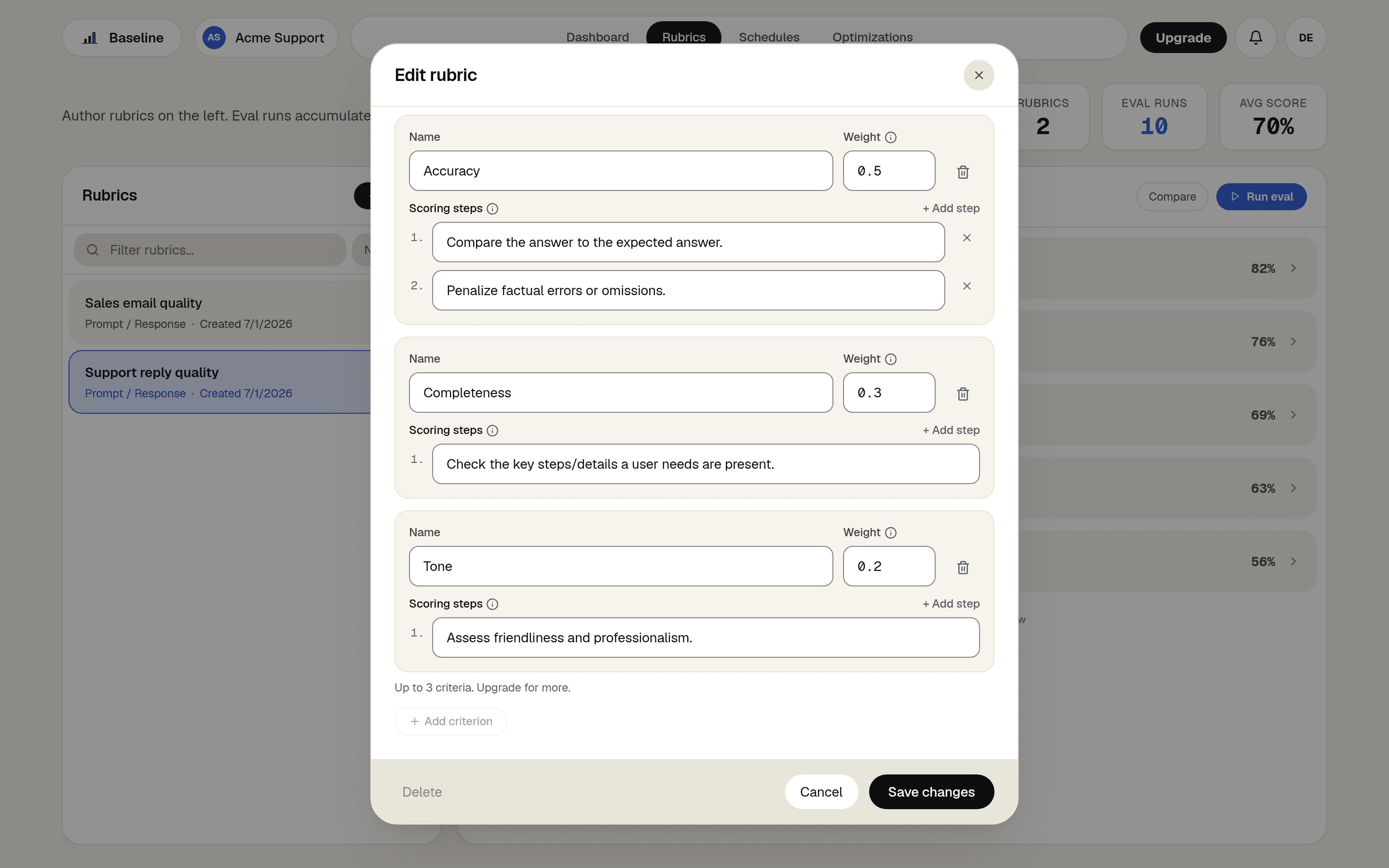
Each criterion carries scoring steps: short, ordered instructions the judge follows the same way every time. Weights say how much each criterion moves the overall score.
The judge scores and shows its work
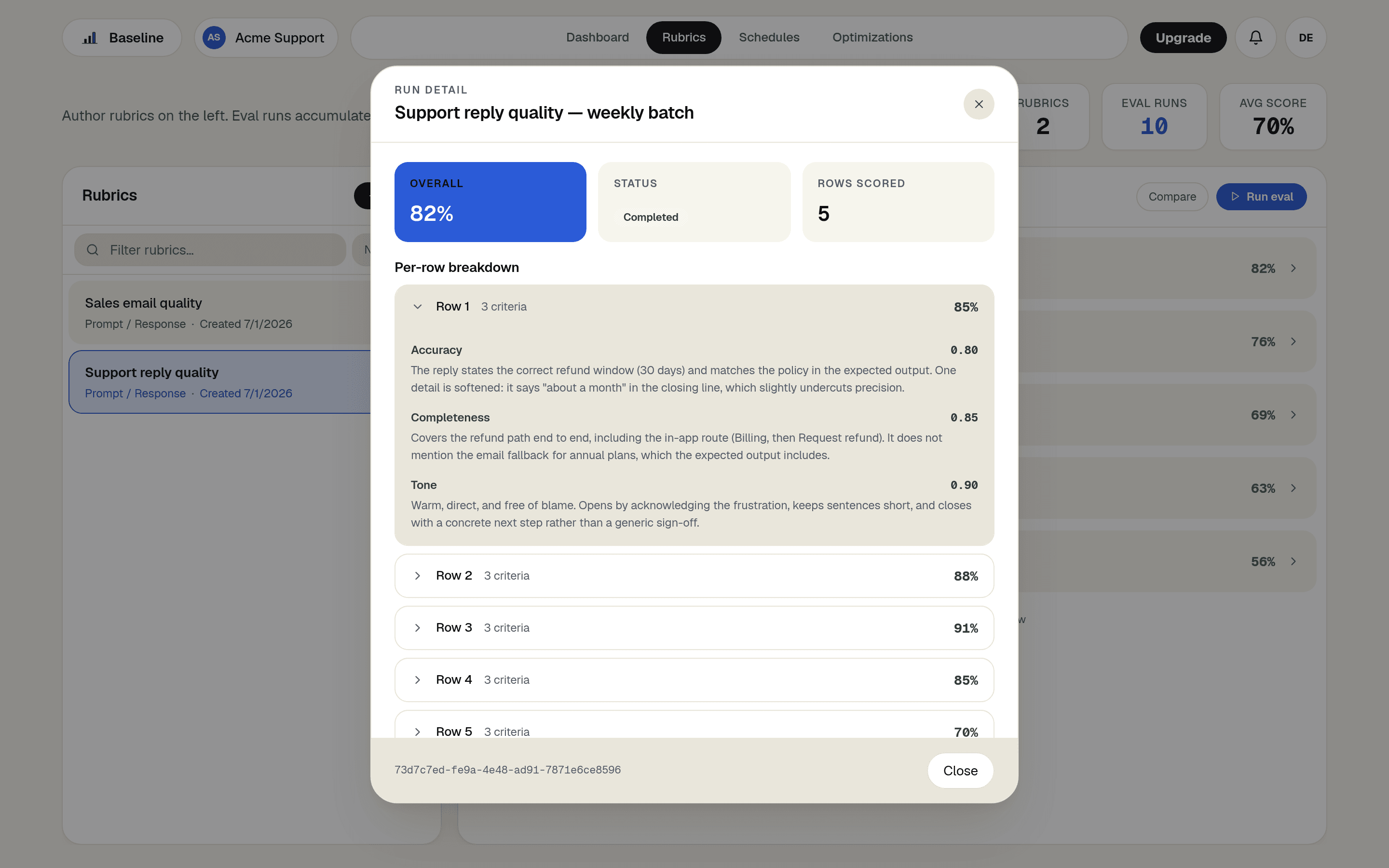
On every row of an Eval Run, the judge scores each criterion and writes down why. The reasoning sits next to the number, so a 0.80 on accuracy comes with the sentence that cost the points.
Same standard, comparable runs
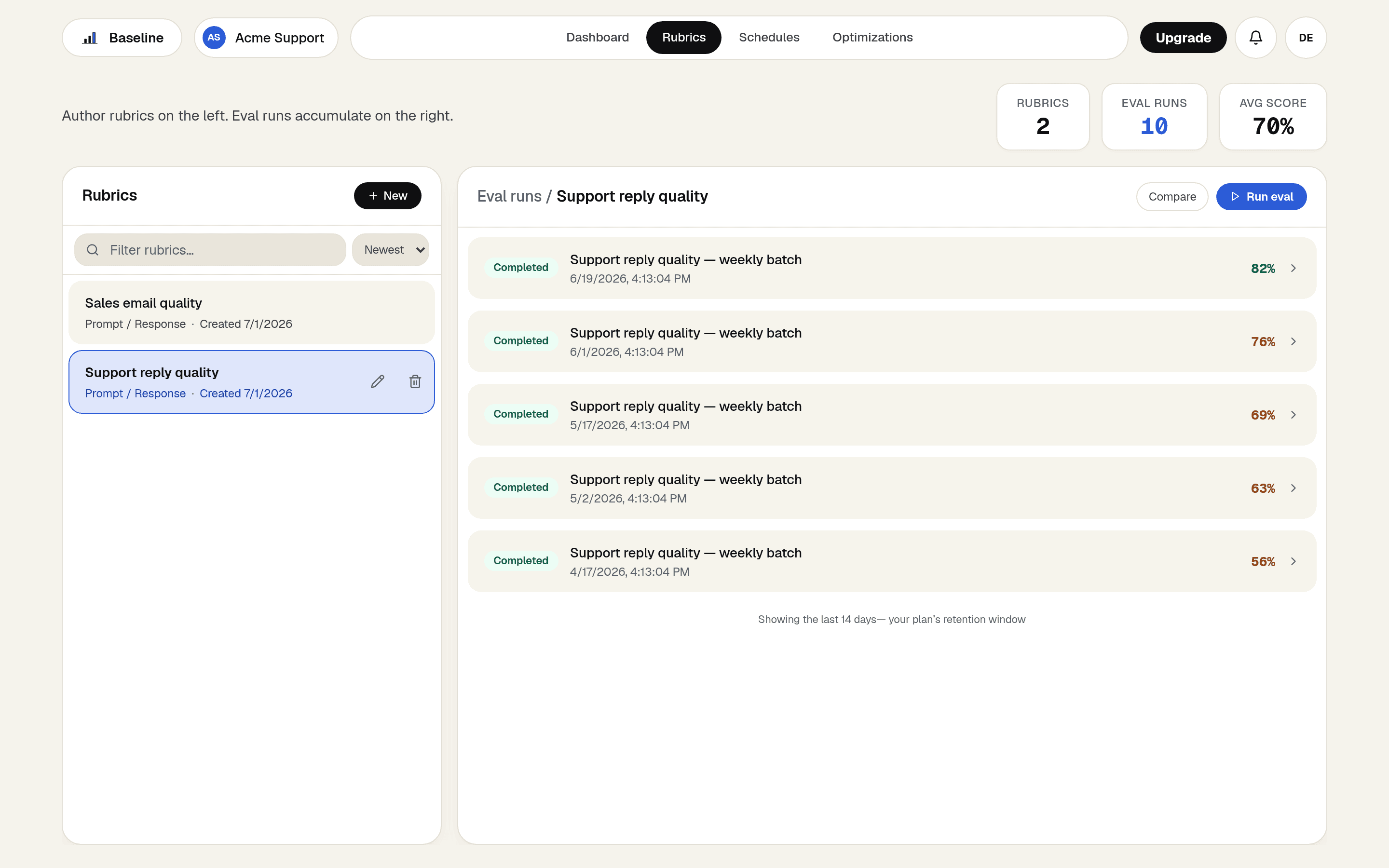
Because the criteria and steps are fixed, scores line up run to run. The history reads as a trend of your AI's quality, graded by the same standard every time.
How Baseline does it
Rubric-anchored judging
The judge grades against the weighted criteria your team wrote, so every score traces back to a standard you can read and edit.
Scoring steps
Each criterion gives the judge explicit steps to follow. Consistency comes from written instructions, the same way it does for a trained human reviewer.
Reasoning you can audit
Every criterion score arrives with the judge's written justification, ready to spot-check, challenge, or use to sharpen the rubric.
Your provider, your key
Bring your own Anthropic, OpenAI, Google, or Mistral key and the judge runs on it. Paid Teams can also lean on Baseline's managed key.
What you get
- Grade thousands of outputs in minutes, at any volume.
- See the reason behind every score, per criterion, per row.
- Keep runs comparable because the grading standard holds still.
- Spot-check the judge and keep your team as the final word.
Frequently asked questions
- Can you really trust an LLM to grade another LLM?
- You can when the judge is anchored to an explicit rubric and its per-criterion reasoning is visible for review. Baseline is built around that grounding, and you can always spot-check or override a call.
- Won't the scores be different every time?
- Drift comes from vague instructions. Scoring against fixed, weighted criteria and written steps makes runs comparable, so a score change reflects a change in your AI.
- Which model does the judging?
- Whichever provider your Team has a key for: bring an Anthropic, OpenAI, Google, or Mistral key and judging runs on it at your own token cost. Paid Teams without a key run on Baseline's managed key.
- Is LLM-as-a-judge a replacement for human review?
- It's a force multiplier. The judge handles the volume, while your team sets the criteria and keeps the final say on the calls that matter.